
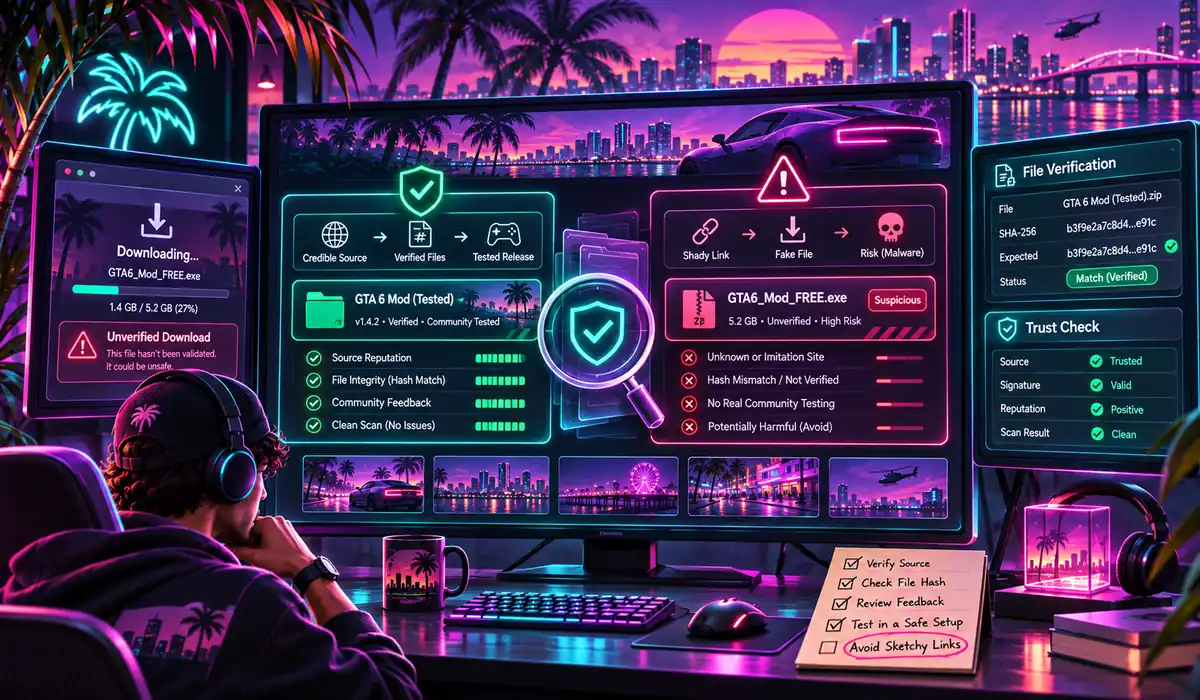
The closer GTA VI gets to release, the more likely a social post is to advertise a 'working mod'. The decisive question is not how attractive the preview looks but what software it actually changes.
General publication and security checks; this site has not examined or certified any native GTA VI mod downloads.
Name the exact target
A real modification should identify the game, platform and version it was built against. 'GTA VI-style police overhaul for GTA V' is a different product from a native GTA VI modification. An unofficial mod description that removes the game name, version and platform leaves a reader unable to test compatibility.
For GTA VI, the November 19 native release is on PS5 and Xbox Series X|S. Rockstar has not announced a Windows release date. An ordinary Windows `.asi` plug-in advertised as supporting a native GTA VI PC executable therefore needs unusually strong supporting evidence.
Ask for a reproducible change, not a cinematic clip
A creator should be able to describe what the mod changes, show it running inside the target game and state the dependencies. For a texture replacement, the demonstration should make the changed material clear. For a script, it should show a detectable action caused by the script, rather than ordinary game footage with captions.
A development video proves only what it visibly demonstrates. A model imported into Blender is evidence of a successful art-workflow step, not proof that the asset has been packaged into GTA VI. Console preload metadata is not evidence of a PC loader.
Inspect provenance before any download
Look for a named author, an official project page, a coherent release history, the actual hosting destination and a list of supported game versions. A hash of the distributed archive can help later integrity checks, but it cannot make malicious software safe on its own. An unknown file that happens to match an attacker-published checksum remains untrusted.
Be suspicious of installers that ask for account credentials, payment merely to reveal a download, browser extensions, antivirus deactivation or a surprise 'launcher' unrelated to the developer's known project. Avoid reposting such packages while their origin is uncertain.
Read the policy and the license separately
Rockstar's current guidelines set boundaries around content, publisher and third-party intellectual property, and creator monetization. A mod being technically possible does not prove that its distribution is authorized. Official Creator Platform documentation is relevant for multiplayer projects, and its scope must be checked for the particular game.
Community tools also carry their own terms. The name of an established tool, such as Sollumz or Script Hook V, should not be borrowed by an unrelated download page to imply endorsement or compatibility.
A practical publication rule
Use explicit status labels such as concept render, GTA V modification, GTA VI compatibility unverified and GTA VI working release verified. The last label needs independent, reproducible evidence on the actual target build. Do not add unsupported download counts, testimonials or a fabricated screenshot gallery.
This approach protects readers and the credibility of a mod index. It also helps genuine creators: someone with a well-documented GTA V project can receive attention without pretending it already runs in GTA VI.
Real-world example: two mod listings received malware warnings
On November 18, GTA5-Mods.com displayed moderator malware warnings on the GTA V projects Underworld Pulse and Schedule V. The site's moderator said the malicious actor used multiple layers of encryption and obfuscation to evade automated scanning. The alert does not imply all GTA5-Mods uploads are compromised, but it demonstrates why a platform listing and a creator biography alone cannot verify a binary.
Before adding any third-party file to a recommendation list, look for active security warnings on the exact source page. A risk assessment has to be updated when new evidence appears. For previously installed software flagged as malicious, device scanning and account-security measures take precedence over game compatibility testing.