
A clip labelled 60 FPS is not necessarily a game running at 60 FPS. GTA VI may render about 30 unique images per second while its PS5 Remote Play feed transports those images over a nominally 60 Hz channel. PC software can then invent pictures between genuine game updates. To assess claims about new GTA VI mods or graphical breakthroughs, editors and players need to name each of those quantities separately.
This methodology is drawn from developer documentation and November 2026 reporting. No gameplay recording was independently measured or benchmarked for this article. FPS counts from modders remain attributed to their creators.
The four frame rates that are often confused
First is the actual game simulation and render rate on PS5. Second is how often the Remote Play codec transmits a frame; a video sent at 60 FPS can repeat images from a 30 FPS game. Third is the interpolator's output rate, including invented images. Fourth is how often the physical monitor refreshes. They are related but not identical measurements.
A simplified 60 Hz stream might contain A,A,B,B,C,C. A tool can remove the copies and synthesize A-to-B transition images, making movement look more fluid. That does not update physics, NPC decisions or controller polling at native 60 FPS.
How to build a credible independent test
Record the unmodified PS5 output, the stream without processing and the processed preview using the same route. State the console model, game build, controller, network, GPU, software version and monitor refresh. Describe what counted as a new source picture, and check whether a clip has repeat frames or incorrectly generated ones.
Include continuous sections with rapid camera movement, cars, pedestrian outlines, foliage and HUD text. A slow cinematic shot can hide artifacts that are obvious while steering through traffic. Measure response to an actual button press as well as output-frame cadence.
What frame interpolation can make worse
Interpolators can distort thin geometry, produce ghost images around moving cars or remove readability from signs. They can also introduce processing and buffering delay after the console sends its already-rendered picture. A 120 FPS-looking video may feel more delayed than direct 30 FPS console gameplay.
A meaningful review compares how the image looks and how the controls respond. One cannot infer input latency from average FPS alone, and neither extra sharpening nor reconstructed pixels create missing engine detail with certainty.
Our editorial verification rule
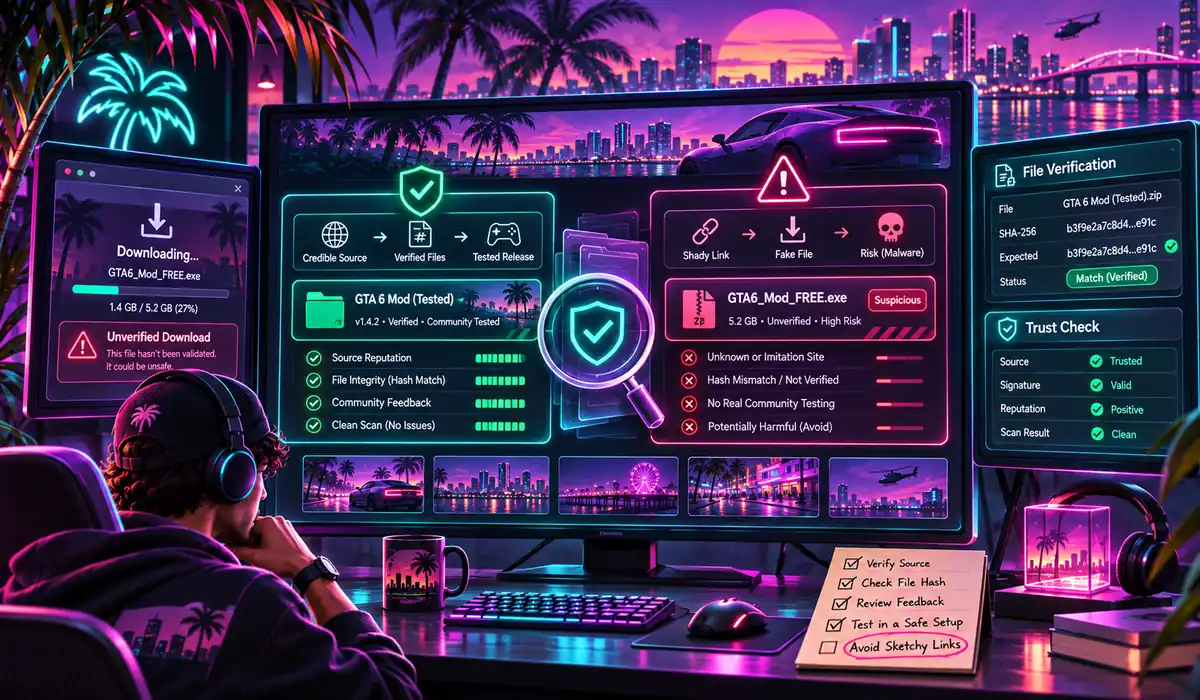
Label frame generation as interpolated display output. Call a tool a GTA VI mod only if it demonstrably modifies supported game assets or gameplay. Cite author claims with their test conditions, distinguish live from prerecorded demonstrations, and avoid representing a theoretical PC executable or supposed mod menu as an authentic release.
Until a native GTA VI PC edition is announced, stream-processing projects are among the most concrete PC-adjacent experiments available to console owners. Their value is real when stated accurately; falsely calling them native game-engine performance unlocks makes them less useful.
Sources
- Phosphenq — self-reported frame counts and test conditions ↗
- PC Gamer — failed live pairing and processing caveats, November 20 ↗
- VideoCardz — frame-generation explanation and independent-testing status ↗
- SmoovPlay — explicit simulated GTA VI Remote Play demonstration disclosure ↗
- THS — Lossless Scaling technical announcements ↗
- Sony — official Remote Play operation ↗